
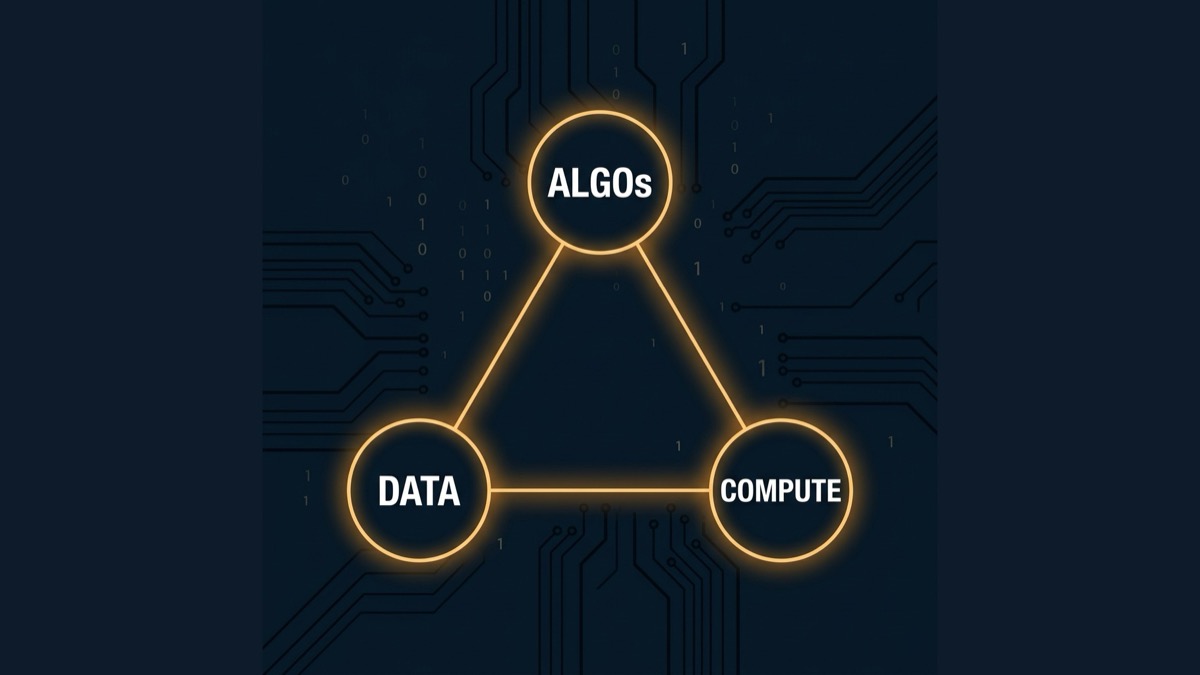
I am currently going through the BlueDot Impact Technical AI Safety course, and one of the study materials that stopped me in my tracks was Ben Buchanan's 2020 paper, The AI Triad and What It Means for National Security Strategy, published by Georgetown's Center for Security and Emerging Technology.
I want to share what I took away from it, in my own words, because I think this framework is genuinely useful for anyone trying to understand why governments are fighting over chips, why talent matters so much in this race, and why "AI strategy" is not as simple as just building more of it.
The paper opens with a sentence that does a lot of work:
Machine learning systems use computing power to execute algorithms that learn from data.
Thirteen words. But those thirteen words contain the whole strategic picture. Algorithms. Data. Computing power. Buchanan calls this the AI Triad, and his argument is that if you understand these three things and how they interact, you understand the actual levers that nations have when competing over AI. Let me walk through each one.
We Moved From Rules to Learning
Before getting into the triad, it helps to understand what changed. For most of computing history, if you wanted a computer to do something, you wrote the rules yourself. You told it exactly what to look for, exactly what to do. This worked fine for structured tasks but broke down badly when the real world got messy.
This has changed with advent of Machine Learning. Instead of writing the rules, you give the system examples and let it figure out the rules on its own. You show it thousands of images until it learns to recognize a face. You feed it medical records until it can spot early signs of disease. You let it play a game against itself a million times until it figures out how to win. The programmer stops encoding knowledge and starts curating data. That shift is what opened the door to everything we are seeing now.
The First Pillar: Algorithms
Algorithms are the part of the triad that get talked about the most in research, but the least in policy. They are the methods a machine learning system uses to learn from data, and they come in three main flavours.
Supervised learning is the most familiar. You give the system labeled examples and it learns to classify new ones. A lot of the AI in military settings works this way. The U.S. military's Project Maven started in 2017 as a program to help analysts sort through drone footage. By 2025, it had grown into a full battlefield management system, processing feeds from satellites, drones, and radar simultaneously, and generating over a thousand targeting recommendations per hour. The kill chain, which used to take hours, now takes minutes. That is supervised learning at operational scale.
Unsupervised learning works without labels. You throw raw, messy data at it and ask it to find patterns. The algorithm clusters things together based on similarity, even if nobody told it what the groups should be. Advertisers use this to find audience segments. The darker use case is that the same technique can map social networks and identify exactly who is most susceptible to a particular message, which is the technical backbone of a lot of modern influence operations.
Reinforcement learning is the one that fascinates me most (maybe because of my background in Mechanical Engineering and interest in autonomous vehicles). The algorithm learns by doing, taking actions in an environment, getting rewarded or penalized, and slowly figuring out the best strategy through trial and error. DeepMind's AlphaZero taught itself chess and Go to superhuman level using nothing but self-play. No human knowledge was baked in, it just played against itself millions of times. The reason national security people care about this is that the structure of a complex game with incomplete information is not that different from the structure of a military operation. The same learning process that masters chess could eventually run autonomous drones in environments where human operators cannot communicate in real time.
The limitation across all three is explainability. These systems produce answers, often very good ones, but they frequently cannot tell you why. That is fine when the stakes are low. When the stakes are targeting decisions or judicial sentencing or medical diagnosis, it becomes a real problem.
The Second Pillar: Data
I had absorbed the "data is the new oil" framing before going through this material, and Buchanan's analysis sharpened my thinking on why that framing is partly misleading.
Yes, data is the feedstock that most supervised learning systems run on. More data, and specifically more relevant, well-labeled data, tends to make systems more capable. But oil is fungible. Data is not. A company sitting on a billion consumer records cannot simply use that to build a military targeting system. The data has to actually match the problem, and collecting the right kind of data in sensitive domains is slow, expensive, and often restricted.
The deeper issue is bias. If the data used to train a system carries historical human biases, the system will inherit and amplify them. The paper uses the phrase "money laundering for bias," which I think captures it precisely. The output looks objective because it came from a machine. The discriminatory logic that produced it is invisible. An algorithm trained on biased criminal justice data will produce biased predictions, and those predictions will be presented as data-driven and neutral. That is more dangerous than an openly biased human making the same call, because at least you can argue with a human.
For national security specifically, a biased threat classification system could misidentify civilians as targets at scale. The absence of explainability makes it harder to catch. These are not hypothetical concerns.
The Third Pillar: Computing Power
This is the pillar I understood the least before this course, and I think it is the most underrated one in public conversation.
Richard Sutton, one of the founders of modern reinforcement learning, wrote something he called the "bitter lesson" of AI research. The lesson is that researchers consistently try to build human knowledge and intuitions into AI systems, and those approaches consistently get beaten by simpler methods with vastly more compute. Scale wins. Throw more processing power at the problem and you tend to get better results than if you try to be clever.
The numbers that make this concrete: between 2012 and 2018, the computing power applied to the largest AI training runs increased by a factor of 300,000. Not 300,000 percent. 300,000 times. That is growing more than ten times faster than Moore's Law. When OpenAI built GPT-2 in 2019, they initially did not release the full model. The reason was not that the algorithm was particularly novel. It was that they had scaled an existing architecture far enough that it could produce coherent, convincing text at a level they were worried about people weaponising for disinformation.
Since then, the compute requirements for frontier models have kept climbing. GPT-4, Gemini Ultra, Claude, the models defining the current frontier all required training runs that would have been unimaginable a decade ago. This is why hardware has become a geopolitical flashpoint.
The United States has been using export controls to limit China's access to the most advanced AI chips. TSMC has been restricted from selling certain advanced chips to specific Chinese firms. ASML, which makes the machines that print the circuits inside those chips, has been progressively barred from selling its most advanced equipment to Chinese buyers. The strategic logic is that if you cannot run the training runs, you cannot build the frontier models.
But here is the complication that the course materials raised and that recent events have sharpened. DeepSeek, a Chinese AI lab, released a model in early 2025 that was competitive with the best Western systems but reportedly cost around six million dollars to train, a fraction of what frontier American labs were spending. Facing hardware constraints, their engineers went deep on algorithmic efficiency. They found architectural innovations that dramatically reduced how much compute you need to get strong performance. Export controls slowed the access to chips. They did not eliminate the incentive to route around chips.
What This Means for Strategy
The triad gives policymakers three distinct levers. Which one is most important shifts depending on where the technology is in its development.
If algorithms are the decisive input, then the most important resource is human capital. The researchers who can design the next generation of learning systems are a small population globally. The United States has historically been the destination of choice for the best of them, drawing talent from everywhere. That is now under pressure from both directions. In September 2025, the U.S. introduced a $100,000 fee for new H-1B visa applications, making it harder to attract the international researchers who have powered American AI. China launched the K visa in October 2025, offering international STEM professionals a path to work in China on research and entrepreneurship without needing prior sponsorship. The talent competition is real and the U.S. is not obviously winning it.
If data is the decisive input, the state has a role that private companies cannot fully play. Governments hold the most sensitive and valuable datasets: medical records, satellite imagery, intelligence archives. How those are curated and made available for research is a form of industrial policy. Equally important is dealing with the bias problem before it gets embedded in systems that affect lives. Some researchers have proposed something like nutritional labelling for datasets and models, mandatory disclosure of what went into training them and where their known failure modes are. We do not have that yet.
If compute is the decisive input, hardware becomes the chokepoint. The semiconductor supply chain runs through a small number of facilities, primarily TSMC in Taiwan and ASML in the Netherlands, and both are subject to significant U.S. and allied influence. Export controls are the active policy tool, and they are being continuously refined. In May 2026, the U.S. issued new guidance to close a loophole that had been allowing Chinese entities to acquire advanced chips through subsidiaries in Southeast Asia.
But there is a domestic side to the compute question that gets less attention. Frontier training runs are so expensive now that only a handful of companies can afford them. If academic researchers and smaller institutions cannot access the compute needed to work at the frontier, the long-term diversity and resilience of the field suffers. Access to compute is not just a thing to deny adversaries. It is also something governments need to think about providing domestically.
Where I Landed
One of the clearest takeaways from Buchanan's analysis, and one that I think has aged well despite the paper being written in 2020, is that you cannot afford to focus on just one pillar.
When the paper was published, data was getting the most attention. The "data is the new oil" framing was everywhere. Since then, algorithmic breakthroughs have repeatedly shown that better methods can compensate for data limitations. DeepSeek made that visceral: architectural innovation can partially substitute for raw compute. The frontier models driving the biggest capability jumps were not primarily data breakthroughs. They were the result of scale, more compute, more parameters, longer runs, combined with increasingly sophisticated training methods.
The practical implication is that a strategy primarily focused on data governance is fighting the last war. Compute is the current bottleneck, and algorithms are where the next disruption is likely to come from. Both deserve more serious policy attention than they are currently receiving.
What I find useful about the triad as a framework is that it resists the urge to find the one thing that matters. Nations that lock in on one pillar will be surprised by developments in the other two. The race is being run across all three dimensions at the same time, by actors with different strengths, different constraints, and different willingness to make trade-offs.
This is part of an ongoing series coming out of my BlueDot technical AI safety course. The course has been pushing me into territory I did not expect, pulling strategic and geopolitical questions into what I thought was going to be a purely technical curriculum. I am finding it is impossible to think clearly about what it means to build AI safely without also thinking about who is building it, why, and with what resources.
More to come.