
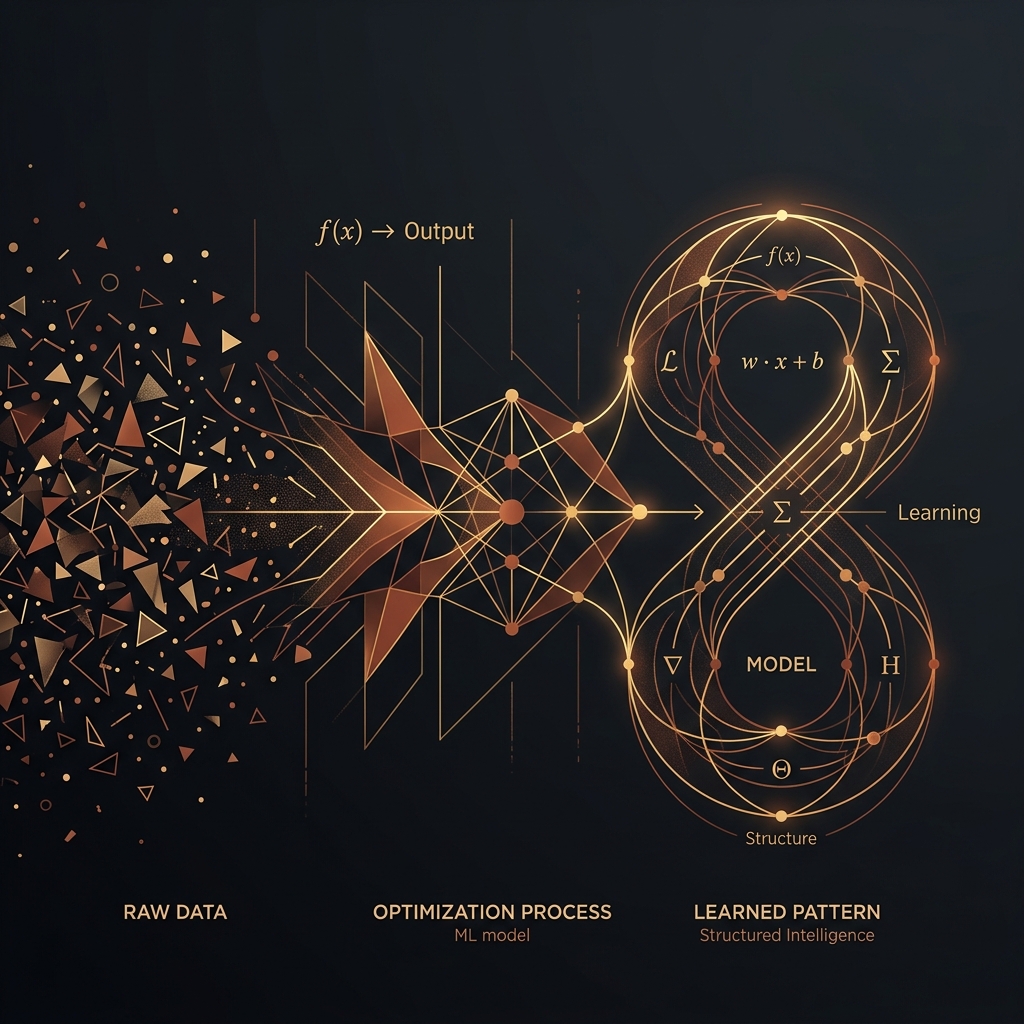
For the last seventy years, if you wanted a computer to do something useful, you had to write a rule. If you wanted it to categorize an email, you wrote a script: if this message contains the word "viagra" and comes from an unknown sender, route it to the spam folder. Programming was fundamentally an exercise in extreme articulation. You could only automate what you could explicitly describe.
But reality is a terrible fit for rigid rules. Try writing a script that tells a computer exactly how to recognize a photograph of a golden retriever. You can't describe floppy ears or eager grins in code. The real world is boundless, messy, and stubbornly resistant to being captured in simple if/then statements.
This is the failure mode of classical computing. And it is exactly the threshold where machine learning begins.
From Rules to Patterns
Machine learning abandons the attempt to codify the world. It doesn't ask you to explain exactly how to solve a problem. It asks you to provide examples of what a solved problem looks like.
If you want to detect a golden retriever, you don't write rules about fur color or snout length. You show the machine ten thousand pictures of golden retrievers, alongside ten thousand pictures of everything else. It chews on the pixels, looking for correlations, textures, and geometric arrangements until it infers the essence of what makes a dog a dog.
You stop writing rules. You start feeding in examples, and the system learns the underlying patterns on its own.
You no longer tell the machine how to arrive at the answer. You show it the destination, and it maps its own way there.
What a Model Actually Does
At the center of this paradigm shift is the model. A model is simply a mathematical function that acts as a vast, multi-dimensional mirror of the relationships hidden inside your data.
When you finish training a machine learning system, what you are left with is the model.
It takes raw, noisy inputs (the square footage of a house, the pixels of a photograph, the text of a user query) and squeezes them through this learned mathematical structure to spit out a highly accurate prediction. That prediction is the entire point.
The Engine of Improvement
But how does a math equation actually learn anything? It learns through feedback. "Learning," in the strict technical sense, is the mechanical process of adjusting the model to be slightly less wrong than it was five seconds ago.
Imagine a person throwing a dart while blindfolded. The first throw misses the board entirely. Someone tells them, "Too far left." They adjust their stance, throw again, and hit the outer edge. "A bit higher now." Throw after throw, micro-adjustment after micro-adjustment, the errors shrink. Eventually, they are hitting the bullseye consistently without ever taking the blindfold off.
This relentless loop of predicting, evaluating the severity of the mistake, and adjusting the internal weights is the beating heart of all machine learning.
The Landscape of Learning
Because the world generates information in radically different ways, machines adapt using different paradigms. The flavor of learning depends entirely on what kind of data you have lying around.
Supervised Learning
Train with cleanly labeled examples. Think flashcards. The model learns by comparing its wild guesses against known, correct answers.
Unsupervised Learning
Dump a mountain of raw data into the system and ask it to find structure. It uncovers hidden groupings that aren't immediately obvious to human eyes.
Reinforcement Learning
Drop the agent into an environment where it takes actions, suffers penalties, and earns rewards to maximize long-term goals. How an AI learns chess.
Generative Models
Instead of predicting outcomes or sorting data, these models internalize patterns so deeply they can dream up entirely new text, images, and code.
Already Running the World
We have already crossed the rubicon. These pattern-recognition engines are no longer confined to academic symposiums, they are running the infrastructure of modern life. They determine what you read on your social feeds, they route delivery fleets through chaotic city grids, and they translate languages in real time.
They are everywhere because the messy, ambiguous reality we live in can't be tamed by rigid rules. It can only be understood by a system willing to stare at the chaos until a pattern emerges.
The revolution wasn't about building a conscious brain. The revolution was abandoning the rulebook entirely, and letting the data lead the way.